Phone Bookings:
0141 459 0005
Clinic address:
22 Milnpark St
Kinning Park
G41 1BB
Email address:
ears@ukearcare.com


That uncomfortable, stuffy feeling in your ears during a flight is a common complaint for travellers. For many, it’s a minor annoyance that fades soon after landing. But for some, it can be painful and worrying. This feeling, often called ‘airplane ear’, happens when the air pressure in your middle ear doesn’t match the pressure in the cabin. The discomfort can be more noticeable on long-haul flights or trips with multiple take-offs and landings.
This guide explains why your ears feel blocked on a plane, offers safe ways to find relief, and clarifies when it’s time to seek professional help from a clinician at UK Ear Care.
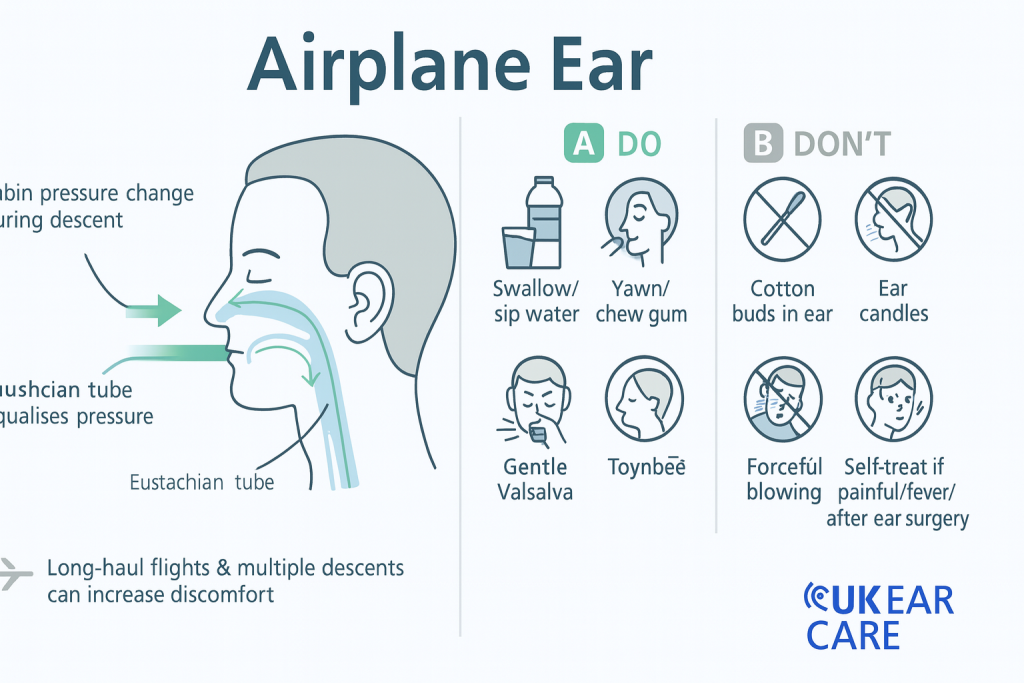
Your ear has three main parts: the outer, middle, and inner ear. The middle ear is a small, air-filled space behind your eardrum. It’s connected to the back of your nose and throat by a narrow channel called the Eustachian tube.
Normally, this tube opens and closes to let air flow in and out, keeping the pressure on both sides of your eardrum equal. You might notice this happening when your ears “pop” as you yawn or swallow. This popping sound is simply the Eustachian tube doing its job.
In children, these tubes are narrower and more horizontal than in adults, which can make it harder for their ears to equalise pressure effectively.
When a plane takes off, the cabin air pressure drops. When it lands, the pressure increases again. These changes happen much faster than your Eustachian tubes can sometimes handle.
If the tube is blocked or narrowed, the pressure difference can cause pain and a sensation of fullness. This is known as ear barotrauma. Several factors can make this more likely:
Certain individuals are more susceptible to ear pain when flying:
A little preparation can make your journey much more comfortable.
The key is to encourage your Eustachian tubes to open, especially during descent, which typically begins 20–30 minutes before landing.
If you feel pain, stop any forceful attempts to equalise your ears.
For most people, any muffled hearing or stuffiness disappears shortly after landing. It might take a few hours, and you may notice your ears popping intermittently as they readjust.
However, if the blockage persists, avoid using cotton buds or ear candles, as these can cause injury or make things worse. If you suspect earwax is the culprit, you can try pharmacy-grade olive oil softening drops for a few days. Do not use drops if you have a known eardrum perforation, grommets, or a history of ear surgery—consult a clinician first.
While most cases of airplane ear resolve on their own, you should seek a professional assessment if you experience any of the following:
If you have a known eardrum perforation, grommets, or have had recent ear surgery, it is important to get checked if symptoms persist. An audiologist can determine the cause of the problem, which could be Eustachian tube dysfunction, fluid in the middle ear, or a wax blockage.
Our NHS-trained clinicians can quickly and accurately diagnose the cause of your blocked ear. During a 30–45 minute appointment, we use a high-powered microscope (otoscopy) to examine your ear canal and eardrum. This allows us to see whether the problem is due to pressure issues (like a retracted eardrum) or an earwax blockage.
If significant earwax is found, we can remove it safely and gently using microsuction, which is the gold standard for wax removal. We also offer gentle water irrigation where clinically appropriate. Our clinics are child-friendly, and we strive to offer same-day or short-wait appointments with transparent pricing.
If you’re planning a trip from Glasgow Airport, prevent discomfort by getting an ear health check with us first. Our clinicians can provide earwax removal before you fly, ensuring your ears are clear and ready for your journey.
If you’ve just arrived at Manchester Airport and are struggling with a blocked ear that won’t clear, don’t wait. We can offer a same-day assessment to diagnose the problem and provide relief, helping you get on with your business trip or holiday.
Flying soon or just landed with a blocked ear?
Book an ear health check today.
FAQs
Why do ears block on planes?
Ears block on planes due to rapid changes in cabin air pressure, especially during take-off and landing. Your Eustachian tube, which connects your middle ear to the back of your throat, can’t always equalise this pressure quickly enough, causing the eardrum to be pushed inwards or outwards.
Is the Valsalva manoeuvre safe—and how do I do it gently?
Yes, it is safe when done gently. Pinch your nostrils shut, close your mouth, and exhale very gently as if blowing your nose. You should feel a soft ‘pop’. Avoid blowing hard, as this can cause pain or damage your eardrum.
Do pressure-regulating earplugs help on long-haul flights?
Yes, many travellers find them helpful. These earplugs have a special filter that slows the rate of pressure change on the eardrum, giving your Eustachian tubes more time to adjust naturally. They are particularly useful during ascent and descent.
Can earwax cause blocked ears when flying?
Yes, a significant buildup of earwax can worsen the sensation of blocked ears when flying. The wax plug can prevent the eardrum from moving freely and interfere with the ear’s natural ability to equalise pressure, leading to increased discomfort or pain.
What should I do if my child cries with ear pain on landing?
Encourage them to swallow, which helps open their Eustachian tubes. You can do this by giving them a bottle, breastfeed, pacifier, or a drink from a sippy cup. The sucking and swallowing actions are very effective at relieving the pressure.
How long should airplane ear last—and when should I see a clinician?
Mild airplane ear often resolves within a few hours of landing. If muffled hearing or pain persists for more than 24–48 hours, or if you experience severe pain, dizziness, ringing in the ear, or discharge, you should see a clinician for an assessment.