Phone Bookings:
0141 459 0005
Clinic address:
22 Milnpark St
Kinning Park
G41 1BB
Email address:
ears@ukearcare.com

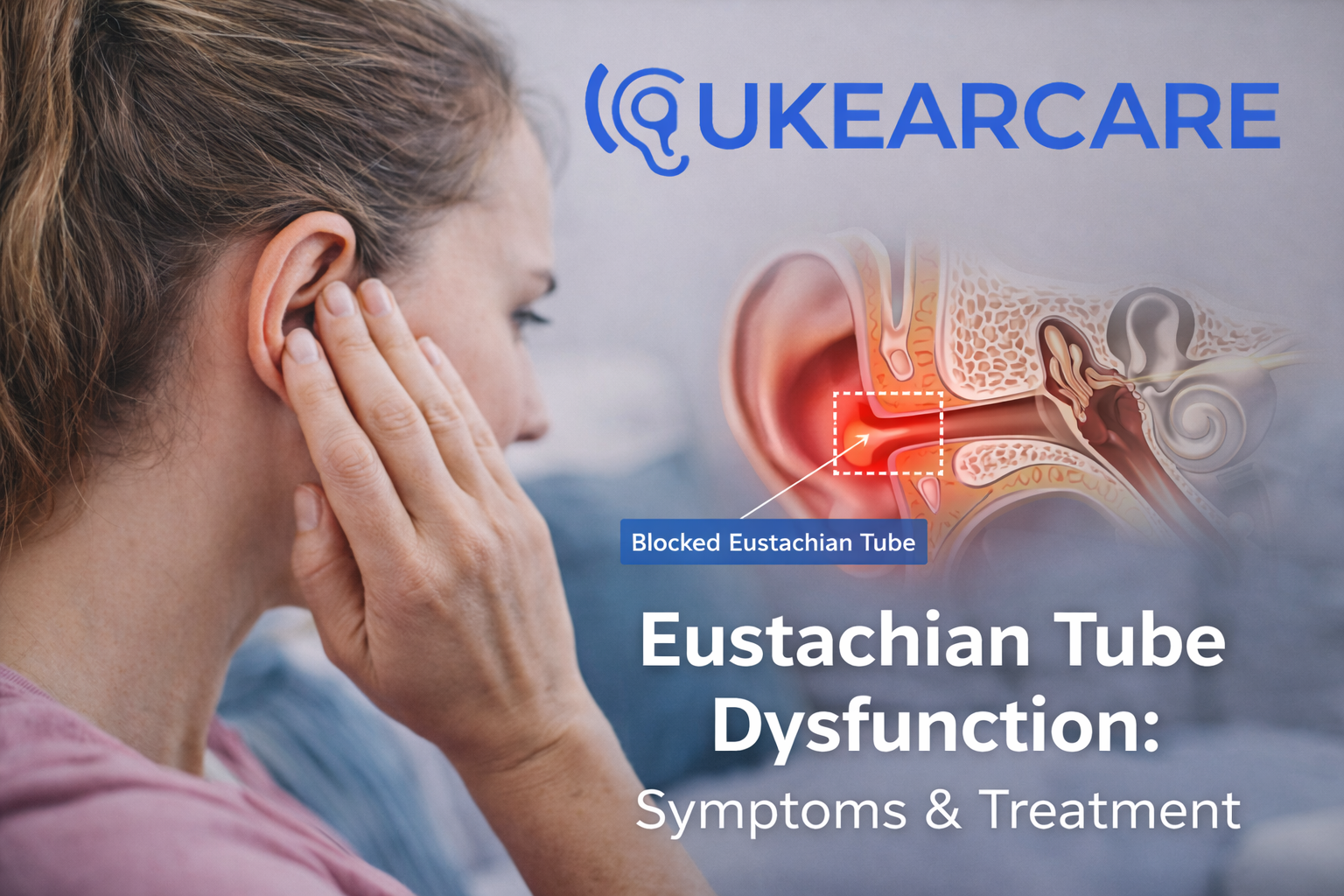
Have you ever felt like your ears are stubbornly “full,” no matter how much you yawn or swallow? Or perhaps you hear a constant crackling sound every time you chew? These frustrations are often dismissed as just “blocked ears,” but they point to a specific and very common condition: Eustachian tube dysfunction (ETD).
While it is rarely a medical emergency, ETD can be incredibly disruptive to your daily life, affecting your hearing, balance, and general comfort. Understanding what is happening behind your eardrum is the first step to getting relief.
To understand the dysfunction, we first need to look at the function. The Eustachian tubes are a pair of narrow channels that connect your middle ear (the space behind the eardrum) to the back of your throat (nasopharynx). They are essentially your body’s pressure valves.
Under normal circumstances, these tubes remain closed, opening only briefly when you swallow, yawn, or chew. This opening action allows fresh air to enter the middle ear, equalising the pressure with the air outside your head and draining any normal fluid secretions.
Eustachian tube dysfunction occurs when these tubes fail to open or close properly. If they stay swollen shut, a vacuum forms in the middle ear, sucking the eardrum inward. If they fail to close (a rarer condition called patulous Eustachian tube), you might hear your own voice or breath echoing loudly inside your head.
Because ETD affects the pressure regulation in your ear, the symptoms often feel mechanical or pressure-related. Common signs include:
ETD is almost always caused by inflammation. When the mucous membranes lining the nose and throat become swollen, the opening of the Eustachian tube gets blocked. The most common triggers include:
Diagnosing ETD usually involves a combination of discussing your symptoms and a physical examination. A specialist or GP will likely use an otoscope to look inside your ear.
They aren’t looking for wax (though they will check if it’s there); they are looking at your eardrum. In cases of ETD, the eardrum often looks retracted—sucked inwards—due to the negative pressure. It may also appear dull if there is fluid trapped behind it.
In some clinical settings, a tympanometry test may be performed. This painless test measures how well your eardrum moves. If the eardrum is stiff or doesn’t move as it should, it confirms a pressure issue in the middle ear.
The good news is that most cases of ETD resolve once the underlying inflammation (like a cold) goes away. However, treatments are available to speed up recovery or manage chronic symptoms.
If your symptoms are mild or you are waiting for an appointment, several simple techniques can help encourage your ears to “pop” safely:
While annoying, ETD is usually harmless. However, you should seek professional advice if:
It is particularly important to verify that the blockage is indeed ETD and not impacted ear wax, as the sensation can be very similar.
Yes, the vast majority of cases resolve on their own, especially if caused by a cold or mild allergies. Once the inflammation subsides, the tubes usually regain normal function within a week or two.
Rarely. It is mostly a quality-of-life issue. However, if left untreated for months, it can lead to “glue ear” (fluid in the middle ear), ear infections, or in rare cases, damage to the eardrum (retraction pockets).
Recovery time depends on the cause. Post-viral ETD (after a cold) usually clears within 1–2 weeks. Allergy-induced ETD may persist as long as the allergen is present. Chronic cases may last months without treatment.
Are your ears causing you trouble?
Don’t guess with your hearing health. Whether it’s stubborn wax or Eustachian tube dysfunction, our experts can help identify the cause and get you the right advice.
Book Your Assessment with UK Ear Care
